My afternoon stroll near Freshwater Hut was partly to calm my nerves at the next day's undertaking. I had heard several tales of how difficult it was; how one couple spent 16 hours walking between the two huts and that hardened trampers who breezed through the North West Circuit reckoned that they wouldn't do it again. There's only one way to assess it and that's to do it yourself. I am not a tramper - I love wandering in the bush but long hikes to get from A to B aren't really my thing.
I hadn't gone far on my recce when I came across orange track markers that had inspirational messages on. They gave me such a boost to my confidence that I photographed them on the stroll back just in case I needed their energy on the tough sections the following day.
What a brilliant idea and my huge thanks to Brando Yelavich for doing this when he was on the island recently. If you don't know Brando's story, please, please visit his website - read his inspirational story and watch his fab video of Stewart Island/Rakiura. Let's ditch the politicians with all their hot air and put youngsters like this in their place.
And how about Squawk Squad too? Their recent kickstarter campaign raised $70,000, three and a half times their target, from ordinary people deciding to do something before it's too late.You can wait for the government and DOC to save our birdlife OR you can band together and actually do something about it!
Thank you to those who inspire and lift others up to make their dreams take flight.
Saturday, June 10, 2017
Friday, June 9, 2017
Coast to Coast - from Mason Bay Hut to Freshwater Landing
The 15km track from Mason Bay Hut to Freshwater Landing
(map courtesy of Google Maps)
|
At this time of year it doesn't
start getting light until about 7.30am so the first two hours of our tramp were
in the dark. The sky was stunningly starlit most of the time; just a few clouds
breezing through but luckily no rain. It was cold though and crossing the
Chocolate Swamp on iced-over boardwalk was a bit freaky. My new friends, Leanie,
Madelane and Ise weren't expecting such a muddy track - they did amazingly well
although we were cutting it a tad fine, arriving at Freshwater Landing only
five minutes before the water-taxi. Phew! We had taken over 4½ hours (DOC time
on signs is 3-4 hours) and whilst I never expect to achieve fast times (I stop
frequently to take photos and talk to the birds), I didn't think we were
walking that slowly either. Just as well we didn't see kiwi and stop to watch,
otherwise Leanie, Madelane and Ise would be spending another night in a DOC hut
instead of hot showers and soft beds in Oban.
| Yay! We made it - thanks, Leanie, for the photo |
I watched the water-taxi leave
then climbed over the bridge to Freshwater Hut to have breakfast.
| Freshwater Hut and swing bridge |
Initially I had planned to climb Rocky Mountain, a 3hr return trip to the top of the hill; I've done it before but it was freezing cold, blowing a gale and visibility was poor. On a clear day the views would be spectacular - right over to Mason Bay on one side and Paterson Inlet on the other. The frequent showers and low cloud made it a no-brainer to shelve it for another time. Just as well I did as I was treated to a male/female kiwi duet at 10.45am and again at 11.15am. I grabbed my camera and walked 50m up the track...
| The track behind Freshwater Hut - wait for it... |
| What a beautiful female and such a poser! |
She walked right past me as I stood on the track and I got the whole close encounter on video. Pure magic!
I spent the next couple of hours cutting firewood. Freshwater Hut is on the cold side of the hill so doesn't get a lot of sun at this time of year. The wood in the woodshed was wet and green and although there's a lot of manuka 'top', there's not a lot of bigger stuff around that keeps the woodburner well-fed. I got enough to keep it burning for a while and also leave enough wood for the next person to use.
| Freshwater Hut and rainbow |
After lunch I went on a recce along the track I'd be doing the next day; I timed myself up to the first stream crossing and then slow-walked back taking photos so I wasn't tempted to have a slow start in the morning. The track winds around beautiful trees - I couldn't resist taking these shots...
| A magnificent rimu with outstretched arms |
...or these of the track...
To save battery power I had an early tea and curled up in my sleeping bag shortly after dark. Kiwi calls accompanied my dreams and thoughts of what tomorrow might bring.
Labels:
freshwater,
kiwi,
mason bay,
rakiura
Coast to Coast - from Oban to Mason Bay Hut via Invercargill
I'm back!! Thank you for your patience and my apologies for taking time out; I'm now on holiday and looking forward to sharing my Rakiura life with you again.
The contract for two of my summer jobs ended 31 May after a very busy season; it was great to meet visitors from all over the world and to share my backyard with them. I never tire of talking about this patch of Paradise and it's a real thrill when others have the same feelings as me about it. I now have two months off before a new contract kicks in so have time to get up to mischief and new stories to tell next season.
Challenge #1: Walk from the west coast to the east coast
Stewart Island Flight's Coast to Coast involves a flight and beach landing at Mason Bay, a 4hr hike across to Freshwater River and a 45 minute water-taxi ride out to Oban. There are DOC backcountry huts both Mason Bay and Freshwater River; great for staying a night or two with kiwi-spotting a regular occurrence. I've been over to Mason Bay three times but have always got a water taxi out, thus avoiding Thomson Ridge - a steep and challenging 6-7hr tramp around to North Arm Hut, with a further 4-5hr walking back out to Oban. I've heard a lot of horror stories about Thomson Ridge but felt I had to do it myself so I knew what it was like.
No work, a settled patch of weather and a spur of the moment decision saw me waiting down at Stewart Island Flights after a hurried pack for my big adventure. My first surprise was an unplanned flight to Invercargill - the low cloud and drizzle had settled in and could have prevented the plane coming back to pick me up. After picking up three more passengers we headed back across Foveaux Strait and around the north/west coasts down to Mason Bay.
I love exploring at Mason Bay so meandered up to the hut via the dunes rather than the track; still lots of feral cat tracks, hopefully the harsher weather will reduce numbers right down over the winter. I followed kiwi and deer prints and hunkered down in the lee of a ring of dunes to have my lunch.
Lots of amazing plants in the dunes, too - I could easily spend a week there!!
Back to the hut for dinner - it gets dark early now so I needed my head torch inside. I hope I have enough battery power, especially seeing how we're leaving early the next morning to walk over to Freshwater Landing - my new friends that I flew in with have to meet the water-taxi at 10.15am for their ride back to Oban. I sat outside for a while watching the stars get covered briefly by clouds and listening to kiwi call, then curled up in my sleeping bag and waited for the 5am alarm.
The contract for two of my summer jobs ended 31 May after a very busy season; it was great to meet visitors from all over the world and to share my backyard with them. I never tire of talking about this patch of Paradise and it's a real thrill when others have the same feelings as me about it. I now have two months off before a new contract kicks in so have time to get up to mischief and new stories to tell next season.
Challenge #1: Walk from the west coast to the east coast
Stewart Island Flight's Coast to Coast involves a flight and beach landing at Mason Bay, a 4hr hike across to Freshwater River and a 45 minute water-taxi ride out to Oban. There are DOC backcountry huts both Mason Bay and Freshwater River; great for staying a night or two with kiwi-spotting a regular occurrence. I've been over to Mason Bay three times but have always got a water taxi out, thus avoiding Thomson Ridge - a steep and challenging 6-7hr tramp around to North Arm Hut, with a further 4-5hr walking back out to Oban. I've heard a lot of horror stories about Thomson Ridge but felt I had to do it myself so I knew what it was like.
Thanks to Google for the maps - Codfish Island/Whenua Hou
is the large bump in the top left hand corner of Stewart Island
|
| Rather murky conditions but nice and calm |
| I think this is West Ruggedy Beach |
| Flying past Red Head Peak and the Ruggedy Mountains range |
| Our Piper Cherokee Six preparing for take off from Mason Bay |
My lunch spot - a ring of dunes around a flattened area
about the size of a tennis court
|
| Kiwi probe holes all over the place |
| Gunnera hamiltonii |
Deer prints - probably whitetail although I think there are red deer
over here too
|
| Earina autumnalis (Easter orchid) ripening seed head |
| Late-flowering Earina autumnalis native orchid |
| Another shower as the sun sets |
Native pingao, Desmoschoenus spiralis, coming back after a
concerted effort to eradicate exotic marram grass
|
| Raoulia sp aff hookeri - a native mat daisy growing in the sand |
Labels:
Coast to Coast,
Freshwater Hut,
mason bay,
rakiura
Sunday, January 8, 2017
The Great Animal Orchestra
A very wet day and 760Mb data to use up before it renews on Tuesday is a fine recipe for sitting inside and blogging. Happy New Year to readers - may miracles happen this year for all things on this glorious planet.
My list of interesting books is growing weekly and I've had a fine time delving into unknown waters. The Great Animal Orchestra by Bernie Krause is a fascinating read, accompanied by examples of the book's soundscapes on his website at http://www.thegreatanimalorchestra.com/
Bernie Krause started with sound before he was 4 years old; first learning the violin in 1942 and then the guitar. He was an early adopter of the Moog synthesizer and Dolby A301 noise reduction and a pioneer in recording soundscapes (see the Wikiepedia definition here) and bioacoustics. Check out his website at http://www.wildsanctuary.com/ for more information.
The book touches on the author's early history with sound but, for me, the spell he weaves is relating how sound affects the lives of living things. He splits sounds into three categories - geophony (sounds made by non-biological sources, eg thunder), biophony (sounds made by non-human, non-domestic biological sources, eg frogs) and anthropophony (sounds made by humans, eg jet ski). What sounds were made 16,000 years ago? How has it changed with man's spread around the globe? How and why do living things make sound?
The narrative is easy reading; the technical stuff a bit more challenging for me but well-explained. When I got double-glazing installed here, I really missed not being able to hear the night-sounds. I toyed with the concept of putting in hardware that could pick up sounds outside the house and play them to me inside. I read a bit on the internet but got bogged down with how to achieve it and put the idea in the too-hard basket. Krause has re-ignited this idea and I'm more aware now of what I will need. Splash Audio will be my next point of call once work quietens down. There are several websites with recommendations for hardware but not many recent ones - and of course technology that's 5 years old is no longer available to buy. Will keep you posted!
A few startling facts from Krause's book...
The book also explores the origins of music based on the biophony/geophony of the environments the people lived in - waterfalls, rivers, the sea, birdsong. Krause calls it an "acoustic mirror - it reflects our culture and our surroundings at any point in time". There are many examples that are lightbulb moments for me - if I have piqued your interest put this book down on your 'to read list'.
My list of interesting books is growing weekly and I've had a fine time delving into unknown waters. The Great Animal Orchestra by Bernie Krause is a fascinating read, accompanied by examples of the book's soundscapes on his website at http://www.thegreatanimalorchestra.com/
Bernie Krause started with sound before he was 4 years old; first learning the violin in 1942 and then the guitar. He was an early adopter of the Moog synthesizer and Dolby A301 noise reduction and a pioneer in recording soundscapes (see the Wikiepedia definition here) and bioacoustics. Check out his website at http://www.wildsanctuary.com/ for more information.
The book touches on the author's early history with sound but, for me, the spell he weaves is relating how sound affects the lives of living things. He splits sounds into three categories - geophony (sounds made by non-biological sources, eg thunder), biophony (sounds made by non-human, non-domestic biological sources, eg frogs) and anthropophony (sounds made by humans, eg jet ski). What sounds were made 16,000 years ago? How has it changed with man's spread around the globe? How and why do living things make sound?
The narrative is easy reading; the technical stuff a bit more challenging for me but well-explained. When I got double-glazing installed here, I really missed not being able to hear the night-sounds. I toyed with the concept of putting in hardware that could pick up sounds outside the house and play them to me inside. I read a bit on the internet but got bogged down with how to achieve it and put the idea in the too-hard basket. Krause has re-ignited this idea and I'm more aware now of what I will need. Splash Audio will be my next point of call once work quietens down. There are several websites with recommendations for hardware but not many recent ones - and of course technology that's 5 years old is no longer available to buy. Will keep you posted!
A few startling facts from Krause's book...
- In 1968 there was 45% of old growth forests in the Lower 48th (USA) still standing; by 2011 there was less than 2%
- 83% of land area in the Lower 48th is now within 2/3rd mile (1.07km) from a road
- recording one anthrophony-noise-free hour of material takes more than 200 times longer than 40 years ago
- In Krause's estimation, anthrophony can be heard in more than 80-90% of wild habitats much of the time
- Sound levels in movie trailers with THX or Dolby Digital sound systems are now more than a factor of six greater than they were in the early 1990s
- More than half of Krause's soundscapes (15,000 species, over 4,500 hours) can no longer be heard or are seriously compromised
The book also explores the origins of music based on the biophony/geophony of the environments the people lived in - waterfalls, rivers, the sea, birdsong. Krause calls it an "acoustic mirror - it reflects our culture and our surroundings at any point in time". There are many examples that are lightbulb moments for me - if I have piqued your interest put this book down on your 'to read list'.
Labels:
Bernie Krause,
rakiura,
soundscape,
The Great Animal Orchestra
Saturday, December 31, 2016
Farewell to 2016
The last day of the year again! How do 365 days go so quickly? I barely got into double figures for blog posts this year yet not sure where the extra time went to. It seems to be a sign of the times and my resolution for 2017 is to smooth the chaos and make every day count. Wish me luck!!
I've had a busy December working at Stewart Island Lodge; early starts mean that I hear the glorious dawn chorus as I'm getting ready for work. Last week's sun rise was at 5.49am and I was in bed before the sun set at 9.42pm, no wonder kiwi are seen occasionally during the day as there's less than 6 hours of darkness in December. I've heard 6 kiwi calls since Christmas Eve - a duet at 4.36am, a duet the following night at 10.57pm, a female call 3 days later and another at 2.38am this morning. There were small kiwi-like prints on the drive so perhaps there's a wee one exploring with its Mum.
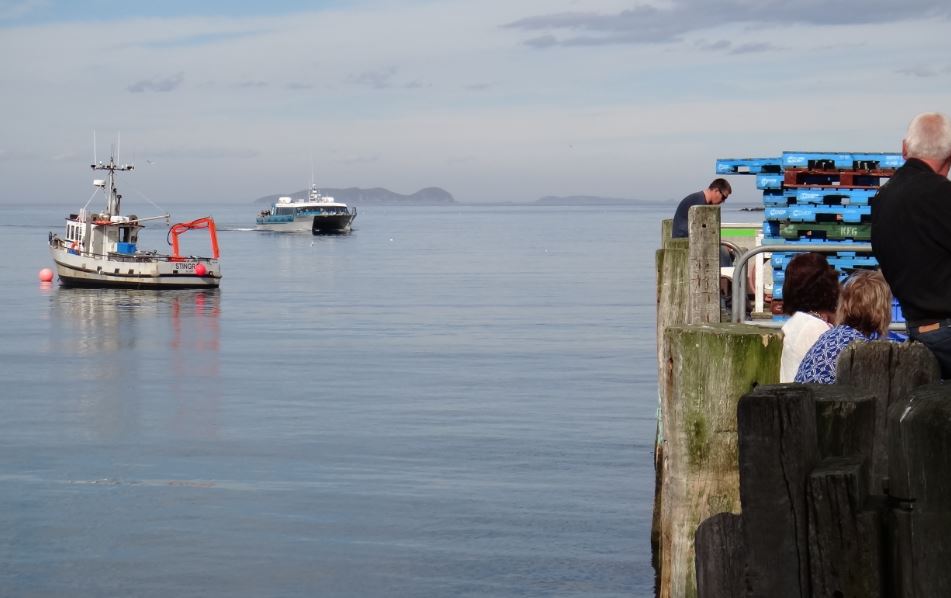
I've spent more time down at the wharf this month; I don't usually meet the Lodge guests but I had to pick up a radiator key that was being sent over on the 5pm ferry from Bluff so went down early and took photos...
The conditions were a lot calmer than on Tuesday this week when gale force winds forced the cancellation of the afternoon's ferries from Bluff and from the island. Accommodation is always tight between Christmas and New Year so it was extra-challenging finding beds for all the visitors that were stranded. Everyone that I was involved with took it in their stride though and came out to breakfast the next morning with smiles on their faces.
I've been reading lots of good books lately - hmm, maybe that's why I haven't been blogging!! Will post some reviews when I have time. Eleven years ago I did a 'New Zealand Native Plants' course by correspondence and that one semester paper changed my life. The evidence that we are damaging our Mother Earth for future generations of ALL species is hard to ignore and I think that 2017 will be a pivotal year; are we prepared to change our habits and work toward a more sustainable future? Let's hope so.
I've had a busy December working at Stewart Island Lodge; early starts mean that I hear the glorious dawn chorus as I'm getting ready for work. Last week's sun rise was at 5.49am and I was in bed before the sun set at 9.42pm, no wonder kiwi are seen occasionally during the day as there's less than 6 hours of darkness in December. I've heard 6 kiwi calls since Christmas Eve - a duet at 4.36am, a duet the following night at 10.57pm, a female call 3 days later and another at 2.38am this morning. There were small kiwi-like prints on the drive so perhaps there's a wee one exploring with its Mum.
| A sunny evening in Paradise |
| Stewart Island Lodge at the top of the picture |
| Ferry arriving from Bluff |
| The Foveaux Express coming in to dock |
I've been reading lots of good books lately - hmm, maybe that's why I haven't been blogging!! Will post some reviews when I have time. Eleven years ago I did a 'New Zealand Native Plants' course by correspondence and that one semester paper changed my life. The evidence that we are damaging our Mother Earth for future generations of ALL species is hard to ignore and I think that 2017 will be a pivotal year; are we prepared to change our habits and work toward a more sustainable future? Let's hope so.
Labels:
rakiura,
Stewart Island Lodge
Sunday, December 11, 2016
Summer serenity
The tourist season is getting into its stride and I am enjoying sharing my backyard with the guests staying at my workplace, Stewart Island Lodge. My first visit to Rakiura in 2009 is vividly etched on my memory and I hope all visitors leave happy and relaxed and with fond memories of this extra-special place.
I haven't had a lot of time for slow walks lately so it's nice to have long, sunny evenings to go orchid-hunting. Most of the spider orchids have finished their flowering although my special clump has lasted longer than most...
...and now it's the time for the greenhoods, Pterostylis, and the bamboo orchid, Earina mucronata
The Aporostylis, Caladenia and Drymoanthus are budding up and there's a miniature forest of sun orchid, Thelymitra, appearing - they usually flower in January but the seasons seem to be mixed up - no doubt I'll be posting photos as soon as they are out! My large patch of green bird orchids, Chiloglottis, were a bit displaced by kiwi probe holes a couple of months ago; there must have been a lot of juicy worms there.
My last photo was my attempt to go 'arty'. I was walking past the Cenotaph when I noticed a wee poppy flowering among the rocks - it must have seeded from the ones planted last season.
| Above and below: Early morning panorama from the Lodge deck |
I haven't had a lot of time for slow walks lately so it's nice to have long, sunny evenings to go orchid-hunting. Most of the spider orchids have finished their flowering although my special clump has lasted longer than most...
...and now it's the time for the greenhoods, Pterostylis, and the bamboo orchid, Earina mucronata
| Pterostylis in flower on the roadside bank near home |
| View from the top |
| Close-up of Pterostylis flower |
My last photo was my attempt to go 'arty'. I was walking past the Cenotaph when I noticed a wee poppy flowering among the rocks - it must have seeded from the ones planted last season.
Labels:
orchid,
pterostylis,
rakiura,
spider orchid,
Stewart Island Lodge
Subscribe to:
Posts (Atom)